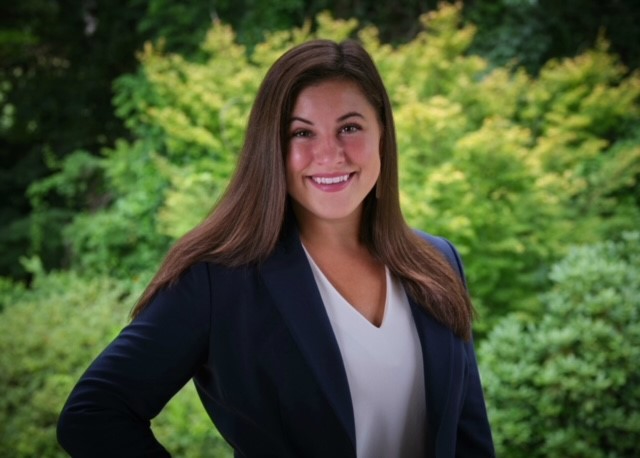
I had the privilege of interviewing Mrs. Taylor Revenew, A CDC attorney, a few weeks ago and wanted to share some highlights from our three-hour conversation.
Mrs. Revenew had an unconventional pre-law path– law school wasn't on her mind until early in her senior year of undergrad. As a senior at the University of Georgia (UGA), Mrs. Revenew was only a year out from graduating with a B.S. in Health Promotion, but she wasn't entirely certain what her career path was going to look like.
Curious about her post-undergrad options, she reached out to a current UGA Law student from her hometown to learn more about attending law school. That conversation proved pivotal, and it sparked a realization that healthcare law was going to be the next step in her educational journey.
She applied early through the UGA Scholars Program; a program that high-achieving UGA undergraduates can pursue to secure admission to the top 20 law school. It allows undergraduates to apply without taking the LSAT, and it requires a minimum 3.5 GPA and have scored at or above the 85th percentile nationally on either the SAT or ACT at the time of administration ("Scholars").
She was accepted to UGA Law, and committed to her state flagship institution, enjoying a seamless transition between undergrad and graduate studies. This became useful while navigating the intense workload and adjustment that the first semester of law school requires.
Throughout law school, in addition to being president of the UGA Health Law Society, she pursued various internships, externships, and summer associate opportunities. For instance, the summer after her first year of law school (1L), she was a legal and bioethics intern at Memorial Health University Medical Center in Savannah, Georgia. Her 2L spring semester, she began her journey with the Centers for Disease Control and Prevention Office of the General Counsel (CDC OGC) as a legal extern. The summer following her 2L year, Mrs. Revenew was a summer associate at a large medical malpractice defense firm in Atlanta, GA. Additionally, she spent a semester as a legal extern in the Medicaid Fraud Control Unit of the State of Georgia Office of the Attorney General.
After graduating from law school, Mrs. Revenew worked as a medical malpractice defense attorney for nearly three years. She enjoyed getting her hands dirty in the extensive medical records, speaking to medical professionals to gain expert perspective, analyzing the weaknesses and strengths of a case, and taking complex medical cases and breaking them down for a jury to understand. She recalled discovering that medical malpractice attorneys on the plaintiff side reject around 98% of the potential cases they review. This is due to the high cost of pursuing medical malpractice cases– it typically runs firms 20-300k nationally depending on the complexity of the medical malpractice case (Hastings). Especially for firms that get paid based on contingency, this means that firms on the plaintiff side will typically not take a case unless they believe the following four factors are fulfilled: "That a doctor-patient relationship existed, that the provider's care fell below the accepted standard of care, that this failure directly caused the injury, and that the injury resulted in quantifiable damages" (Hastings).
During her time in private practice, Mrs. Revenew also became acquainted with the tedious nature of billables: an attorney norm of having to take meticulous notes of how much time one spends on specific work or tasks for various clients' cases. Firms typically track time in six-minute increments, and keeping track of these records is essential for firms to get paid for their work.
While working in private practice, Mrs. Revenew was contacted by an attorney at CDC OGC that she worked with during her externship, and she was informed of an opening for an attorney within CDC OGC. As it was always her dream to make her way back to CDC OGC, she excitedly applied for and was offered the position. In her work at OGC, Mrs. Revenew primarily advises the Division of Regulatory Science and Compliance (DRSC), which administers three programs: the Federal Select Agent Program, the Import Permit Program, and the U.S. National Authority for the Containment of Poliovirus. She also recently began advising the National Center on Birth Defects and Developmental Disabilities (NCBDDD). DRSC works to ensure that scientific research conducted in laboratories, especially on select agents and toxins, is conducted as safely and securely as possible.
The Federal Select Agent Program (FSAP) is managed jointly by DRSC and the Animal and Plant Health Inspection Service's Division of Agricultural Select Agents and Toxins (part of USDA) ("About Us"). FSAP oversees the possession, use, and transfer of select agents and toxins. DRSC regulates the agents and toxins that can cause disease in humans, while DASAT regulates those that can cause disease in animals and plants. Agents that have the potential to pose a threat to both public health and to animal health or products are regulated by both agencies. ("About Us"). A few examples of select agents and toxins are monkeypox virus, severe acute respiratory syndrome coronavirus (SARS-CoV-CoV), and ebolavirus ("Part 73").
DRSC also administers the Import Permit Program (IPP). This program regulates the importation of infectious biological materials that can cause disease in humans to prevent the introduction, transmission, or spread of communicable disease from foreign countries into and throughout the U.S. ("About Import"). Most commonly, permits are issued to laboratory facilities at government agencies, universities, and private and commercial laboratories. In 2024, IPP conducted 101 Import Permit inspections to ensure that the appropriate biosafety measures were in place. ("About Import").
Lastly, DRSC administers the U.S. National Authority for Containment of Poliovirus (NAC). The U.S. Department of Health and Human Services (HHS) designated the NAC in January 2018 ("U.S."). NAC works to reduce the risk of polioviruses being released from where they are worked with or stored ("U.S.").
Mrs. Revenew has greatly enjoyed her role with CDC OGC, where she appreciates that every day brings on new challenges and constantly evolving science and legal work. Her experience with CDC OGC contrasts her prior work in medical malpractice litigation, where cases generally followed a structured arc of discovery, depositions, and trial preparation.
In my opinion, one of the coolest parts about her work at the CDC as an extern and attorney has been the unique opportunity to work on unique legal issues surrounding individuals who have been exposed to infectious diseases, such as COVID-19 and most recently, hantavirus.
Additionally, her Health Promotion coursework, including cadaver labs, anatomy, physiology, and biology, proved valuable in both her medical malpractice work, where she had to learn and understand complex medical procedures, and in her current role advising CDC scientists on the intricacies of the select agent and toxin regulations.
Overall, it was an amazing experience getting to speak with Mrs. Revenew and gain insight on her experiences in the public and private sectors of healthcare law as well as at UGA Law.
Works Cited
- "About Import Permit Program | Import Permit Program | CDC." CDC Import Permit Program, U.S. Centers for Disease Control and Prevention, 20 Jan. 2026, www.cdc.gov/import-permit-program/php/about/index.html.
- "About Us | Federal Select Agent Program." CDC USDA Federal Select Agent Program, Federal Select Agent Program, www.selectagents.gov/overview/index.htm. Accessed 15 July 2026.
- "ECFR :: 42 CFR 73.3 -- Hhs Select Agents and Toxins." National Archives Code of Federal Regulations, Office of the Federal Register, www.ecfr.gov/current/title-42/chapter-I/subchapter-F/part-73/section-73.3. Accessed 15 July 2026.
- Hastings, Tommy. "Why Won't a Medical Malpractice Attorney Accept My Case?" Hastings Law Firm, Hastings Law Firm Medical Malpractice Lawyers, 3 May 2026, www.hastingsfirm.com/why-wont-attorney-accept-my-medical-malpractice-case/.
- "Scholars Admission Process - UGA School of Law." University of Georgia School of Law, University of Georgia, www.law.uga.edu/scholars-admission-process. Accessed 15 July 2026.
- "U.S. Poliovirus Containment | U.S. National Authority for Containment of Poliovirus | CDC." CDC U.S. National Authority for Containment of Poliovirus, U.S. Centers for Disease Control and Prevention, 15 Oct. 2024, www.cdc.gov/poliovirus-containment/php/us-containment/index.html.