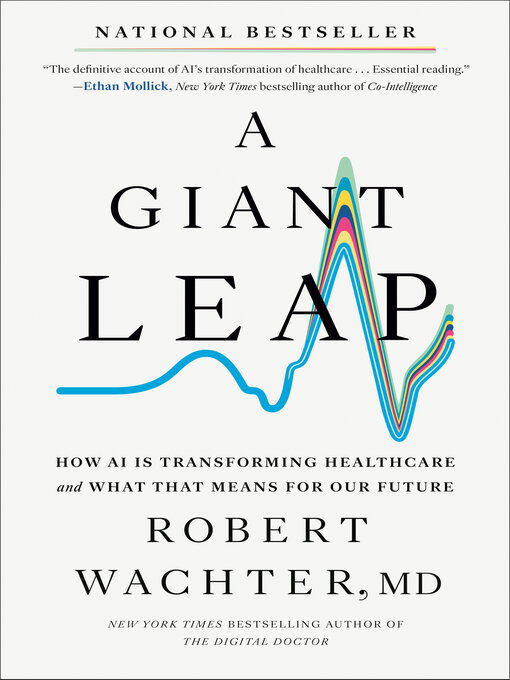
“Doctors used to be empathic,” he told me, “but the system has sucked the soul out of everybody.”
— A Giant Leap, page 186
The slow erosion of the patient-doctor relationship in the United States the past few decades has been caused by a mixture of electronic health record (EHR) implementation, the shortage of healthcare providers, and the nature of how our healthcare system is funded– being billed per service. The ideal of having a lifelong relationship with your primary care provider is not the reality most of us share.
This erosion has reduced trust in this relationship which serves two distinct purposes as artificial intelligence technologies are implemented across healthcare– it makes it easier for patients to trust in newly implemented AI tools due to the lower level of trust in the current system and harder because they may question the tools’ accuracy and the motives behind institutional adoption (Wachter 50).
Patients may think AI, as it is used in other sectors, is a way to decrease labor costs and increase margins.
But AI can, and is doing both, all while performing at higher levels of accuracy than providers in some instances. For instance, when faced with the “famously vexing cases” of The New England Journal of Medicine, generative AI was on par with the best faculty diagnosticians (Wachter xix).
The doctor-author remarks on this insight with the humorous remark: “Was this how it felt to be a skilled portrait painter in the late nineteenth century, when photography emerged as a much faster and cheaper way to capture people’s likenesses?”
Although we aren’t quite there yet with healthcare AI, in our lifetimes, it is highly probable that the abilities of artificial intelligence will transform the healthcare landscape.
Besides, it’s not like humans are void of making millions of serious medical mistakes a year. As Dr. Watcher points out, “Nearly one million Americans are severely harmed or killed by medical mistakes every year” (xxi). On top of that, one-of-three dollars spent in healthcare are spent on administrative costs– suddenly, incorporating AI to ease administrative costs, and use in clinical practice, as a doctor-in-the-loop is utilized, doesn't seem like such a bad idea.
Actually, it seems like the shake-up that our healthcare system desperately needs.
But, how does the regulatory landscape look like for these technologies that advance every day?
As it's called in Silicon Valley slang, let’s double click on that.
As the Trump administration scales back on the federal government's regulatory arm, FDA commissioner Rob Califf argues “The agency needs more resources to carry out its functions, particularly as new AI tools become ubiquitous features of clinical care” (Watcher 234). Healthcare regulation has always walked a tight-rope: too much regulation and you stifle innovation, too little and you endanger lives. As we give technology greater responsibilities, we must reckon with the risks this may bring.
Generative AI can hallucinate one minute and provide flawless specified output the next, and then act like it “forgot” the specificities of prior conversations the next. Anyone that has played around with Gen AI enough can tell you that much. So, when it comes to the lives of ourselves and our loved ones, how does the dance between biomedical ethics and technological healthcare innovation go? Is it a graceful one?
As long as there’s a human in the loop, many of us would say, given current technological capabilities and for the foreseeable future.
But, there’s a few issues with that; namely, humans are not very good at being vigilant against reliable technologies and de-skilling would likely occur as they become more dependent on these technologies.
One poignant example lies in the 2009 Air France Flight 447 crash off the coast of Brazil. As the plane’s airspeed sensors failed, the pilot and copilot were on their own to guide the plane through a strong gust of wind. An event that wouldn't have typically been anything special became the scene of a fatal incident, as 228 people plunged into the Atlantic Ocean.
In the words of the late aviation journalist William Langewiesche, “We are locked into a spiral in which poor human performance begets automation, which worsens human performance, which begets increasing automation” (Watcher 87).
But before you write off this troubling incident as the crime of two bloody hands, and not of human nature, take a look at this study.
“In a dramatic 1998 study, research psychologist Kathleen Mosier placed twenty-one experienced commercial pilots in a flight simulator. During the flight, the pilots were shown a warning light pointing to a potential fire in one of the engines. The twist was that several other indicators showed no signs of a fire, making it overwhelmingly likely that this was a false alarm. Nevertheless, all twenty-one of the pilots shown the warning light decided to shut down the engine, a dangerous move. In subsequent interviews, two-thirds of the pilots reported having seen at least one other indicator confirming the fire (several recalled seeing more than one), despite the fact that there were no such cues, a phenomenon Mosier dubbed “phantom memory.” Our trust in technology can become so powerful that we ignore our own senses, creating a special problem for the human in the loop” (Watcher 88).
Hard to read, right? Especially considering this aspect of human psychology likely has not dramatically shifted since the late 90s.
Another reason why the human-in-the-loop idea may not be as strong as we think: sometimes the human makes it worse, particularly in clinical diagnostic reasoning.
In a study run by Stanford informatics expert Jonathan Chen, “Physicians were given cases to review; half (the control group) were allowed to use their usual resources, and half were given access to GPT-4. The control group ended up with a score of 74 percent on a measure of diagnostic reasoning, whereas the group with access to GPT-4 scored 76 percent– a trivial improvement. The shocker was that when GPT-4 was given the cases to review by itself, without any input from the physicians, it scored 92 percent” (Watcher 90).
There are a few alternative solutions to keeping a more direct human-AI partnership while keeping the nature of us in mind, including having the doctor to be the first to weigh in and having AI systems periodically give false diagnoses, chart summaries, or recommendations (Watcher 91). However, this latter strategy puts an essential glass ceiling on healthcare AI capabilities. Isn’t the whole point of the man-machine collaboration to advance beyond capabilities man can exceed alone, to the furthest achievable point to benefit humanity?
There is no right answer to many of these kinds of questions when we involve artificial intelligence. But, as AI revolutionizes healthcare, how do we train the next generation of doctors?
With less rote memorization, and a greater skillset in how to use AI tools wisely. Physicians spend 45-65% of their work day staring at a screen, and as AI advances, they will be better able to be caring towards patients they see for 10-15 minute windows. The pace of AI advancement has surpassed that of medical schools curriculum, and something more important– federal regulation.
When Dr. Watcher met with the United States’ chief health AI official in 2024, a newly established position itself, he asked a question that is quite revealing of the healthcare AI federal regulatory landscape.
“‘If we throw a wrapper on GPT-4 and it gives me diagnostic advice when I’m seeing a patient– but I, as a physician, still need to sign off at the end– where does that live in the regulatory framework?”’
His response: “‘Dunno yet’” (Watcher 240).
Although A Giant Leap was released in February of 2026, healthcare AI regulation is still a gray area in many ways, and will continue to be as AI grows in a direction that will force citizens and lawmakers alike to think about technology ethics in this important sector.
As former national coordination for health IT David Blumenthal and Google’s chief of regulatory affairs Bakul Patel argued in writing, “How can the government regulate a single device that could be applied to any conceivable clinical problem, whose knowledge base dwarfs any human’s and changes constantly, whose methods of reaching conclusions are beyond the comprehension even of its creators, and whose computing capacity grows by leaps and bounds?” (Watcher 240-241).
Situated in the center of this debate is the Coalition for Health AI (CHAI) that was founded in 2021 and has over three thousand member organizations including tech giants, academic hospitals, AI start-ups, and government agencies. Most notably, CHAI runs a national network of assurance labs primarily at academic health systems that test and validate healthcare AI tools and provides research-based guidance to promote responsible AI use (Watcher 243). It’s an important organization that encourages transparency and encourages safe AI use in a competitive, yet incredibly important industry: healthcare.
As the AI race moves full steam ahead, it is organizations like CHAI that help fill a regulatory void that the government could not. CHAI makes the healthcare AI industry one step ahead because of the intense and intentional collaboration it fosters, and gives me hope despite the risks and unpredictable issues that come with a revolution in healthcare.
As Mayo Clinic CEO and author Dr. Watcher remarked, in this space, “The risks of going too slowly exceed the risks of going too fast” (258). AI will disrupt the healthcare industry– but not before lawyers, consultants, and accountants feel the heat (Watcher 262).
Healthcare’s primary function is to maximize human health, and if wise AI implementation can assist with that, then let it be– Epic’s monopolistic and anticompetitive practices be damned (Watcher 214-222).
Works Cited
- “Responsible AI Guidance.” CHAI, Coalition for Health AI, Inc, www.chai.org/workgroup/responsible-ai. Accessed 10 June 2026.
- Wachter, Robert. A Giant Leap: How AI Is Transforming Healthcare and What That Means for Our Future. Portfolio / Penguin, an Imprint of Penguin Random House LLC, 2026.