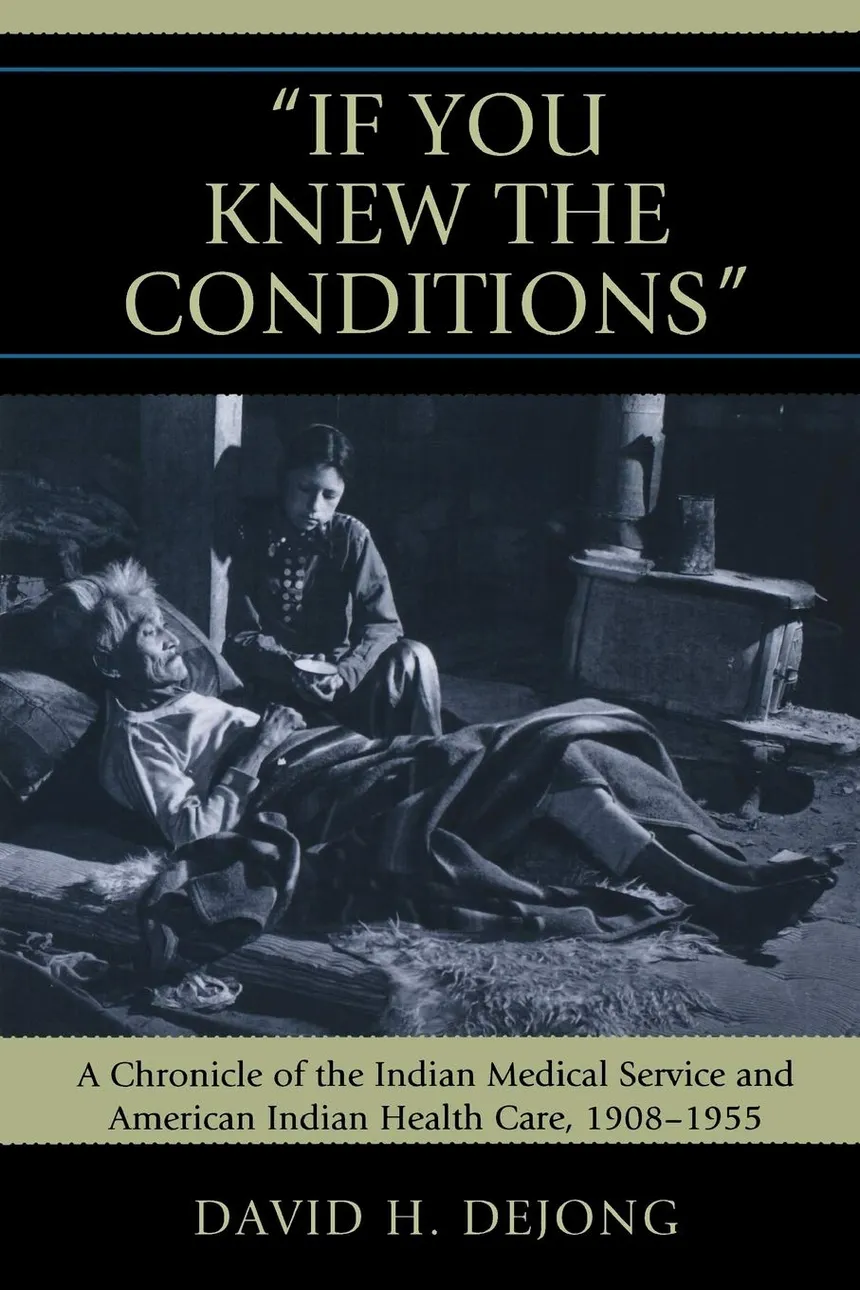
“Take as many whites as there are Indians and give them as much sickness as the Indian has been having, and the whites would soon be poverty stricken, ambitionless, and immoral. The sicker the Indian gets the worse he lives. Health is the basis of all life.”
— Dr. C. A. Harper, Health Officer for the State of Wisconsin, 1933 (pg. 159)
The progressive-minded reformer did not mince words, nor did the President of the American Indian Defense Association and Director of the Institute of Public Health at Columbia University, calling the Indian Service “the most disgraceful apology of scientific or humane medical care” in the country (DeJong 19).
This was in spite of the provisions specifically related to the United States providing Indians health care in 31 out of 389 ratified Indian treaties (DeJong 5).
The Indian medical service’s primary flaws were in its perpetual state of severe under-funding, and the very morals guiding the provision of health care to the Native American community. The curative and crisis-oriented service was oriented to the mission of aiding Indians to complete cultural assimilation– their “only means to salvation” (DeJong 156-157).
For decades, the Indian Service was compelled to be a sub-par organization that did too little to address the various public health challenges Native Americans faced: trachoma, tuberculosis, high material and infant mortality rates, poor sanitation measures, and inadequate and low quality staffing.
The nature of Indian reservations compelled them to be distanced from populated areas and often in isolated, roadless areas.
For instance, “In 1944, for example, the physician vacancy rate exceeded 30%, with 100 vacancies out of 321 positions. One position on the Rosebud Sioux Reservation was vacant for six years before being filled” (DeJong 79).
This was primarily due to physician salaries being about half of that in private practice during more well-funded years, the high physician load (being on-call 24/7, 11 mos/yr), and poor working and living conditions. For example, “One agency physician lived with his wife in a ten by ten room within the hospital” and even the commissioner of Indian affairs, Collier, argued that physicians and nurses worked “under frontier conditions” (DeJong 54; 61; 119).
“By the 1920s, the status of Indian health was at least two generations behind the national average” (DeJong 45). By 1935, enormous progress had been made under Collier’s leadership; however, “Indian health status remained two decades behind that of the general population” (DeJong 102).
The Meriam Report, a 872-page report done by a think tank, the Institute for Government Research, revealed startling health disparities for Native Americans: “Infant and early childhood mortality rates twice the national average and a tuberculosis death rate seven times the national average (with Indians in Arizona experiencing a death rate seventeen times higher)” (DeJong 58-59). Moreover, “In 1954, American Indians faced a measles death rate twenty times the non-Indian rate. Deaths from pneumonia and influenza were four times the non-Indian rate and infant deaths were three times the comparable non-Indian rate” (DeJong 113).
Particularly, there were three populations that suffered the greatest under subpar health care quality and access: children, the disabled, and Alaska Natives.
As Native American children were forcibly ripped away from their communities to attend boarding schools seeking to assimilate them into Western society, they were greeted with overcrowded facilities with poor environmental conditions that caused significantly higher disease rates than in Indians staying at reserves (DeJong 10). Despite 25 years of criticism from the Indian Service, boarding school officials remained disturbingly indifferent (DeJong 59).
Additionally, the lack of pediatricians and nutritionists in the service only contributed to the principal causes of death: infant and childhood diseases (DeJong 113). Furthermore, the Papago Reservation Superintendent reported the tribe’s population which resembled that of medieval Europe: “Of approximately 260 infants born each year, one-fourth die within twelve months; at the age of 6 there are only 160 left; at the age of eighteen only 125.” (DeJong 113).
As for the disabled Native American community, they had their own disturbing history with the federal government: “When Congress enacted into law the Social Security Act of 1935, it required states to provide services for all crippled children, including American Indian and Alaska Native, or face the loss of federal grants-in-aid. Arizona and New Mexico elected to forfeit federal aid rather than provide services for Indian children, basing their decisions on the Indians’ ward (and non-tax-paying) status and their state organic acts, which denied Indian wards services from the state… By midcentury, for example, 145 counties provided services for crippled children. Yet, this covered just 60% of the Indian population. Of this number, only one- third of American Indians had access to such treatment. In order to obtain services, it was common for children to travel 100 miles or more.” (DeJong 112- 113).
As for Alaska Natives, they were let down by the United States by not following their purchase treaty provisions with Russia. The 1867 treaty that states that the U.S. would provide the same care and protection the rest of the nation enjoyed to Alaska Natives was not followed through. The Alaska Native Service was created in 1914, and two years later the first non-school hospital was opened– 49 years after the treaty was signed (DeJong 68).
Considering early U.S. attempts at providing medical care to Native Americans was purely to prevent nearby military post soldiers from contracting infectious diseases such as smallpox, the federal government’s half-hearted attempt at providing Indians healthcare until the 20th century looks comparatively not so bad (DeJong 2). But, the bar is extremely low.
A big part of that stems from how American Indians were not all formally considered citizens until The Indian Citizenship Act of 1924 (DeJong 68). Another concerning fact is that Indian Service funds were often congressionally allocated “Based on the moral principle of charity rather than on any legal obligation”-- troubling, considering the subjective nature of morality, and the ignorance of federal treaties it rested on (DeJong 155).
Facing a post-WWII wave of nationalism and conservatism, the decades-long desire of Congress to squash federal funding towards Native American health was realized (DeJong 130). Through the Indian Health Transfer Act of 1954 local and state health authorities were called to assume greater responsibility for Indian health as the Indian Service migrated into the Public Health Service, a better funded and staffed federal agency (DeJong 130-136).
Present-day tribes are faced with the freedom and responsibility that comes with partially being responsible for ensuring their tribe’s access to health care. They are able to combine Western and traditional medicine approaches in a way that respects their culture, values, and religion with healthcare innovation. The Indian Service still provides care that nearly 25% of Native Americans rely on, and Medicare, Medicaid, and the Children’s Health Insurance Program contribute as well (“Medicaid”; Esch). However, tribes have turned to gaming operations to help fund the health services of their people as well (DeJong 163).
In October 2024, Arizona, California, New Mexico, and Oregon were given waivers that allowed state Medicaid agencies to cover traditional medicine practices (Smithey). These waivers and the terms of approval were developed with Tribal leadership partnerships and advisory groups with the aim to financially support tribes in providing culturally-appropriate health care (Smithey).
Overall, there is still work to be done in reducing health inequities between Native Americans and that of typical Americans. Underfunding and racist ideology and discrimination centrally guided how the U.S. government provided, or lack thereof, of health care to Native communities since the nineteenth century, but, luckily, we’ve come a long way.
Works Cited
- DeJong, David H. "If You Knew the Conditions”: A Chronicle of the Indian Medical Service and American Indian Health Care, 1908-1955. Lexington Books, 2011.
- Esch, Jagger. Native American Health and Medicare, MedicareFAQ.com, 22 Sept. 2021, www.medicarefaq.com/faqs/native-american-health-and-medicare/.
- “Medicaid & Chip for American Indians and Alaska Natives.” HealthCare.Gov, HealthCare.gov, www.healthcare.gov/american-indians-alaska-natives/medicaid-chip/. Accessed 16 June 2026.
- Smithey, Anne. “CMS-Approved Waivers Break New Ground for Medicaid Coverage of American Indian and Alaska Native Traditional Health Care Practices.” Center for Health Care Strategies, Center for Health Care Strategies., 8 Jan. 2025. www.chcs.org/resource/cms-approved-waivers-break-new-ground-for-medicaid-coverage-of-american-indian-and-alaska-native-traditional-health-care-practices/.